Your next hire starts soon. HR has sent the paperwork, the manager has collected some procedure documents, and the learning platform has a list of courses ready to assign. What's missing is an answer to a harder question: How will you know this person can do the job without help?
That gap is common. Only 12% of employees strongly agree that their organization does a great job onboarding new employees, according to Gallup's onboarding perspective. A useful new employee training plan connects instruction to observable work, then gives a named person responsibility for checking it. The calendar matters, but passing the right readiness checks matters more.
Table of Contents
- 90-day new employee training schedule - Build the evidence into the role map - A copyable opening agenda - Training activities compared by what they build - Run a repeatable coaching conversation - Include guidance for AI-assisted work - Readiness checkpoints and pass signals - Fix the operating failuresThe 90-Day Schedule at a Glance
Build the schedule around a progression: understand the work, attempt it with support, then demonstrate independent performance. Treat the dates as planned review points, not automatic permission to move forward.
There's a retention reason to extend support beyond orientation. Gallup's article on onboarding and retention cites SHRM reporting that employee turnover can reach 50% during the first 18 months of employment. That isn't a forecast for your organization, but it's a reason not to confuse a successful welcome with a completed transition.
90-day new employee training schedule
| Phase | Days | Focus | Main activities | Exit check |
|---|---|---|---|---|
| Pre-start | Before day 1 | Outcomes and baseline | Role map, baseline skills check, system access request | Baseline recorded for each hire |
| Orientation | Days 1-7 | Compliance and systems | Policy modules, tool setup, team introductions | Compliance modules passed |
| Guided practice | Days 8-30 | Product, process and supervised work | Short modules, retrieval quizzes, observed tasks | Mastery threshold met on critical items |
| Increasing responsibility | Days 31-60 | Realistic work and coaching | Assigned tasks, weekly coaching, targeted remediation | Sampled work meets the agreed standard |
| Independent performance | Days 61-90 | Scenarios and sign-off | Independent scenarios, role-specific check, manager sign-off | Validated capstone and formal sign-off |
| Ongoing proficiency | Months 4-12 | Full proficiency | Monthly check-ins | Ongoing review against role outcomes |
Say a support agent completes policy training on day three but can't resolve a refund case independently until day 40. That's a hypothetical planning gap, not necessarily a training failure. Schedule supervised cases between those points instead of treating the module certificate as authorization.
Copy the table into a shared document and assign one accountable owner per phase. Use each exit check as the condition for starting the next phase, while allowing already-approved tasks to continue.
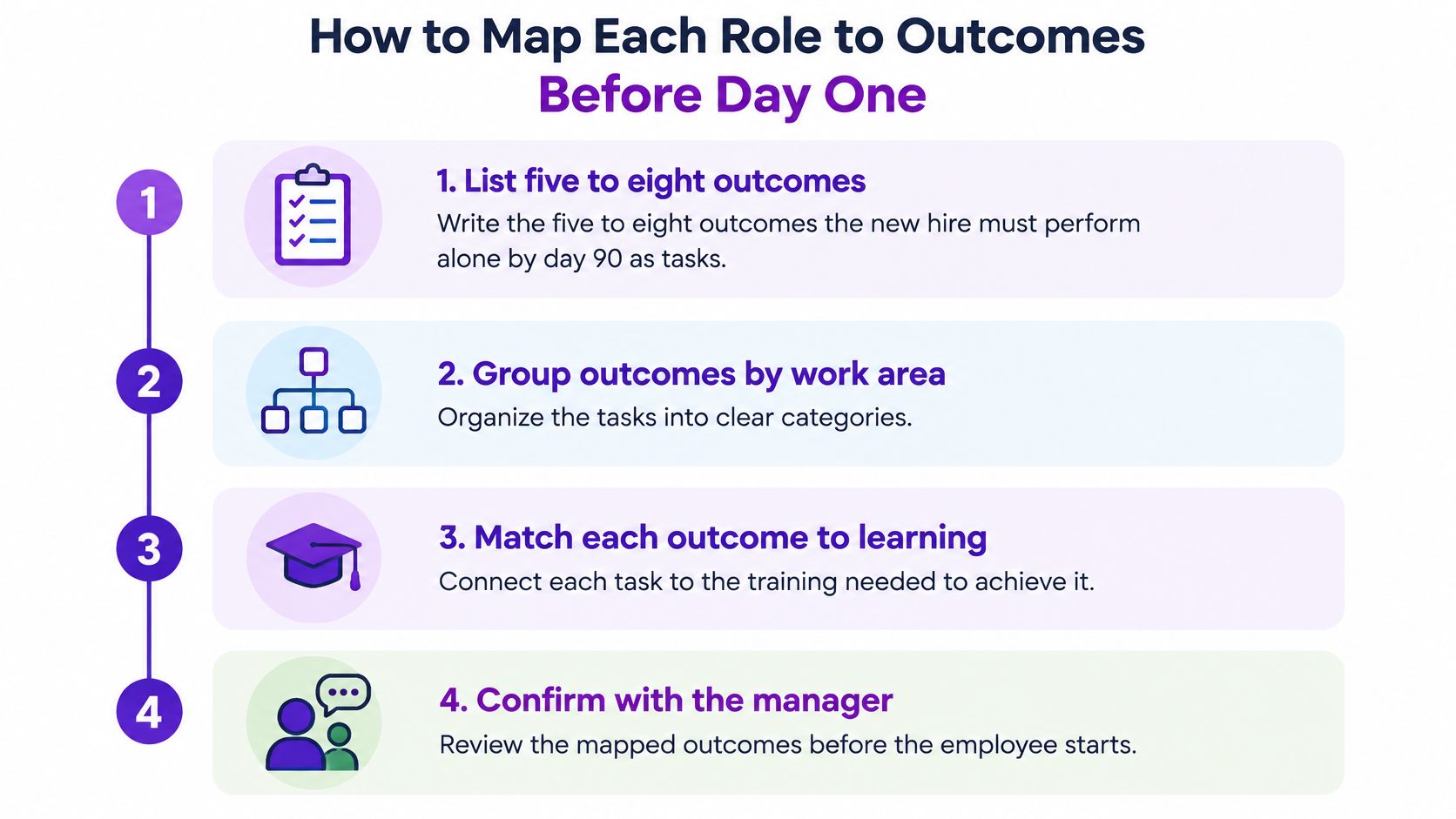
How to Map Each Role to Outcomes Before Day One
Start with work, not the course catalog. A manager needs to describe what successful performance looks like before an instructional designer can decide what to teach.
In a 2025 survey of 1,156 U.S. employees who had started a job within the previous 12 months, 52% said onboarding focused more on administrative tasks than practical job training, according to the TalentLMS and BambooHR employee onboarding report. Paperwork has a place, but it doesn't specify how a new hire should handle an exception, use a system, or make an escalation decision.
Build the evidence into the role map
Use these steps as a working procedure:
1. Write the independent outcomes. Aim for five to eight core tasks for the proposed day-90 review. Write “process a refund within policy,” not “understand refunds.” Group related tasks by work area so omissions are easier to spot. 2. Attach the prerequisites. Record the knowledge, system access, procedure, and compliance requirements each task needs. This prevents assigning a practical exercise before the hire has the tools to attempt it. 3. Prepare a baseline check. Use a short scenario or sanitized work sample before day one, during an agreed assessment window. Don't require productive unpaid work or access to confidential systems. Use demonstrated knowledge to adjust instruction, not to waive mandatory obligations. 4. Specify acceptable evidence. Choose an observed task, sampled work product, or scored scenario. Define what the reviewer must see, including errors that require a stop. 5. Name the verifier. Assign the manager, qualified peer, or trainer. Confirm that they have both the expertise and calendar capacity to assess the task. 6. Set review dates. Schedule the proposed day-30, day-60, and day-90 reviews, with time for reassessment if the hire needs more practice.
For a hypothetical hire handling regulated customer information, the compliance lesson might explain identity verification. The practice task should require the hire to verify a simulated customer, refuse an inappropriate disclosure, and record the decision correctly. A qualified reviewer observes the whole sequence.
When organizing corporate training, keep the outcome map separate from the lesson inventory. The map works when the manager can name the required result without opening the course list.
A Day-by-Day First Week
Make the first week usable as a calendar, not a reading assignment. The agenda below is a suggested operating pattern; adjust the timing to the employee's contracted workdays, shift, and access requirements.
A copyable opening agenda
- Day 1, expectations and access. Give the hire the role map and discuss the baseline result privately. Reserve a manager conversation to agree on the intended outcomes, then test core tool access together. A login invitation isn't proof that the system works.
- Day 2, essential obligations. Run short sessions on applicable data handling, safety, and other mandatory requirements. Follow each with a brief retrieval quiz. Explain why an answer is wrong, and resolve critical misunderstandings before exposing the hire to the relevant risk.
- Day 3, workflow demonstration. Ask a peer buddy to demonstrate a complete workflow. Have the hire narrate the steps back, including where they would stop and ask for help.
- Day 4, purposeful introductions. Arrange individual conversations with the people the hire will depend on. Give each meeting a topic, such as escalation ownership, quality review, or customer handoffs.
- Day 5, supervised execution. Let the hire attempt a low-risk task, such as a sandbox refund. The trainer records the result, prompts used, and any errors, rather than marking attendance.
- Days 6 and 7, process reinforcement. On the next scheduled working days, assign a short process lesson, a retrieval check, and the current version of the team's procedures. Don't turn the agenda into an expectation of weekend work.
Hold that review on the final working day of the opening week. It gives the manager a chance to correct misunderstandings while the work is still supervised, rather than discovering them during a later performance review. Record what support was promised and who will provide it.
Choosing Activities That Build Real Competence
Choose an activity for the evidence it can produce. A quiz can check whether someone remembers an escalation rule; a simulation can show whether they recognize when to apply it. Neither should be mistaken for unrestricted readiness across the entire role.
The ASA Team article summarizing onboarding evidence describes a systematic review in which supported on-the-job training produced a large role-clarity effect (d = 0.87) and instructor-led situated or simulated training produced a large competence effect (d = 1.35), while the review rated the overall certainty of evidence as low. Those findings favor supported practice, but they aren't a guarantee of results in your team.
Training activities compared by what they build
| Activity | Best for | Evidence in the review | Watch out for |
|---|---|---|---|
| Supervised on-the-job practice | Real job tasks | Strongest evidence for structured, supported workplace training | Needs a named coach and clear standards |
| Instructor-led simulation | Decisions and rare cases | Clear competence benefit for situated or simulated instruction | Requires realistic scenarios and feedback |
| Self-paced e-learning | Policies, systems and product facts | Doesn't establish that content alone replaces coached practice | Completion does not show skill |
| E-learning plus preceptorship | Structured knowledge with coaching | No confirmed effect in one intervention | Preceptor time must be scheduled |
| Shadowing | Seeing how work flows | No separate effect established in the available summary | Passive unless the hire acts afterwards |
Keep the practical design disciplined:
- Use realistic conditions. Include incomplete information and ordinary exceptions, not just ideal cases.
- Use the actual tools safely. Prefer a sandbox or controlled training account where mistakes won't affect customers.
- Protect coaching time. Put preceptor sessions in the calendar before assigning the lesson.
- Make shadowing active. Require the hire to attempt the workflow afterwards.
How Managers Run Weekly Check-Ins
Managers need a routine they can execute, not a general instruction to support the hire. Give them task results, conversation prompts, and authority to adjust assignments.
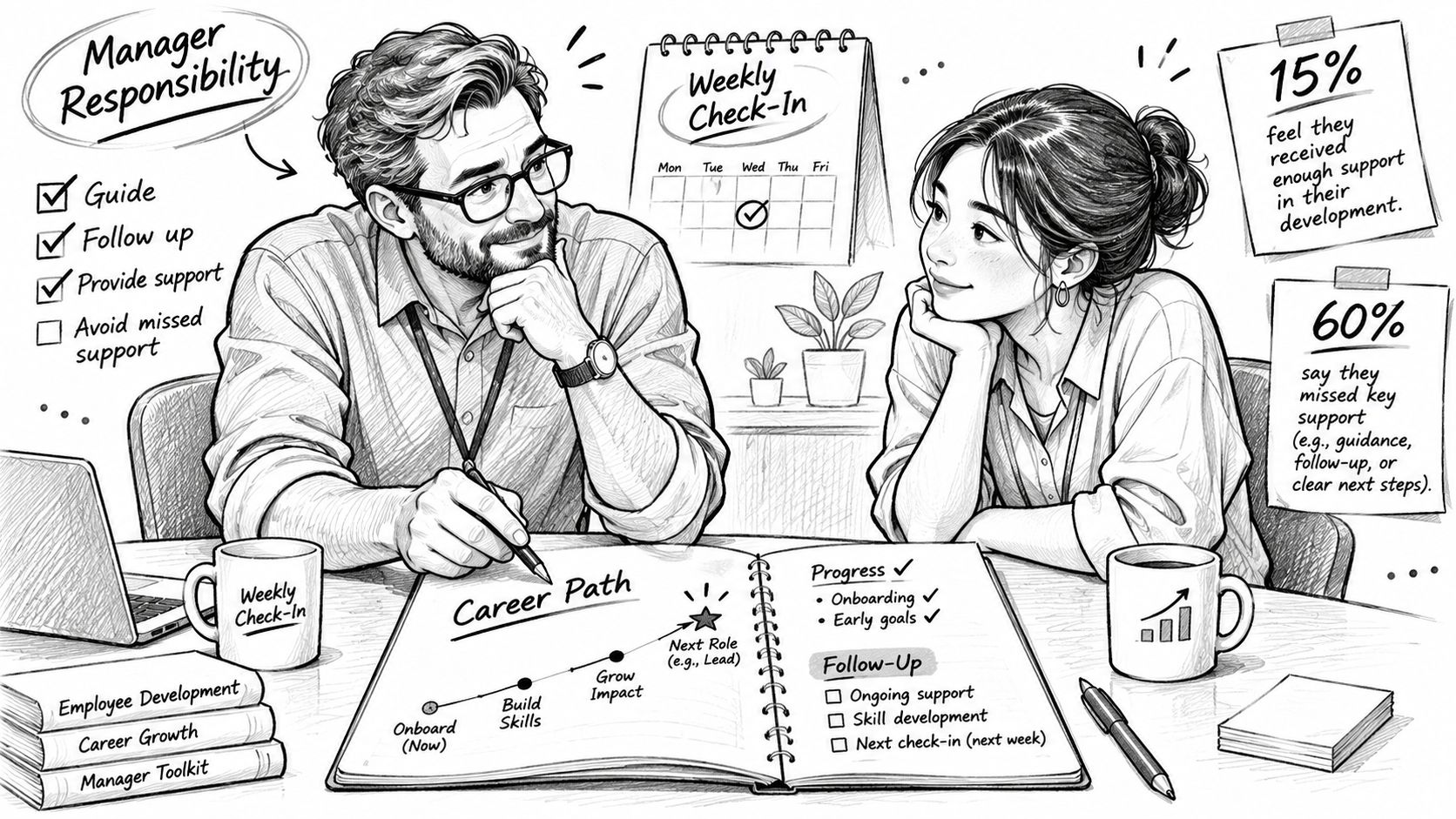
Only 15% of employees said their manager had helped them build a career plan in the previous six months in LinkedIn's 2025 Workplace Learning Report. Career planning isn't the same as onboarding coaching, but the finding cautions against assuming that developmental conversations will happen without explicit ownership.
Run a repeatable coaching conversation
1. Inspect the work. Review recent task results alongside what the hire found difficult. Ask where they needed prompts or intervention. 2. Ask for an explanation. Have the hire explain a completed task in their own words, especially the decision points. Don't let a polished final output conceal guesswork. 3. Choose the next practice task. Agree on a manageable assignment and define what acceptable completion looks like. 4. Record targeted support. Translate quiz errors or observed mistakes into a specific action, such as practicing escalation decisions with a trainer. 5. Log the touchpoint. Record the date, commitment, and owner. Keep sensitive feedback in the appropriate restricted record.
Maintain a common baseline for mandatory obligations and organizational expectations. Adapt the remaining path to demonstrated proficiency, work location, and role risk. An experienced remote hire may need little instruction on the software but deliberate introductions to decision-makers.
Include guidance for AI-assisted work
If the role uses AI tools, cover approved uses, prohibited inputs, output verification, and human accountability. A support employee should know whether customer information can enter an approved tool and who checks a drafted response before sending it.
Make the escalation rule explicit in your operating procedure. A workable proposal is that two missed checkpoints trigger a manager-and-trainer review within five working days. Use that meeting to inspect workload, access, instruction, and coaching availability before treating the problem as lack of effort.
Readiness Gates and Fixing Common Failures
A readiness gate should answer a specific authorization question: What work can this person now perform, under what conditions, with how much supervision? It shouldn't reduce the employee to a single pass-or-fail label.
Use secondary benchmarks cautiously. The Stealth Agents onboarding statistics summary illustrates the problem with broad vendor-style retention and productivity claims: they depend on study design and shouldn't become universal promises. Your decision needs evidence from the role, the learner, and the actual work.
Readiness checkpoints and pass signals
| Checkpoint | Timing | What it measures | Pass signal |
|---|---|---|---|
| Baseline skills check | Before day 1 | Starting knowledge for the role | Gaps listed for the adaptive path |
| Module quizzes | Days 1-30 | Recall of critical knowledge | Mastery threshold met on critical items; remediation if missed |
| Work sample review | Day 30 | Quality and error rate on real work | Sampled tasks meet the agreed standard |
| Mid-point review | Day 60 | Time to first independent task and rework rate | Rework trending down; manager-rated role clarity improving |
| Capstone | Day 90 | Role-specific scenario performance | Capstone passed against the rubric |
| Formal sign-off | Day 90 | Manager judgment against role outcomes | Signed off, or a dated remediation plan with one owner |
Track assessment accuracy, scenario performance, time to an independently completed task, rework, manager-rated role clarity, and time to a predefined productivity level. Compare cohorts within comparable roles, accounting for job complexity and manager assignment. Otherwise, a change in case difficulty can look like a training improvement.
> Passing every quiz doesn't override evidence that the employee still needs help doing the work.
Suppose a hire passes the knowledge checks but repeatedly reworks sampled tickets. Hold authorization for that task, assign supervised practice, and retest the specific weakness. When sign-off fails, write a dated remediation plan with a named owner and an observable measure.
Fix the operating failures
- Overloaded opening week. Move nonessential instruction closer to the task that requires it.
- Completion-only reporting. Add an assessed work sample to each practical phase.
- Missing manager coaching. Reserve the recurring conversation before the employee starts.
- Unversioned procedures. Record the owner, revision date, and change description, then check whether assessments still match.
- Premature independent release. Restrict unapproved tasks while allowing work the hire has already demonstrated safely.
Confirm the Plan Before Your First New Hire Starts
Confirm the operating commitments before building more content. The immediate decisions are who owns the role map, who observes practice, and who can authorize independent work.
Use this week to make the plan executable:
- Finish the role map and diagnostic. Ask the manager to approve the required outcomes and assessment conditions.
- Assign phase ownership. Put activities, reviewers, and reassessment time into a shared calendar.
- Book the gates. Reserve the proposed day-30, day-60, and day-90 reviews before operational meetings consume the time.
If the mapped instruction needs to become a course, our AI-assisted authoring can turn existing materials into outlines, lessons, and quizzes for your review and editing. Publish the finished course through a learner-tracked share link, a downloaded PDF, or a SCORM export. Keep workplace authorization with the qualified reviewer.
Choose one role for next week. Approve its outcome map and prepare the baseline check for the next hire before expanding the approach.
---
LearningStudioAI helps you create editable course outlines, lessons, and quizzes from your onboarding materials. Visit LearningStudioAI to build the instructional part of your new employee training plan, then pair it with observed practice and manager-owned readiness gates.